
Book Review: Suplex & Sorcery, by June Orchid Parker
“…In other words, the story really is a love letter to professional wrestling, and it shows, in a lighthearted and fun way, how a wrestling league might form in a sword and sorcery city.”
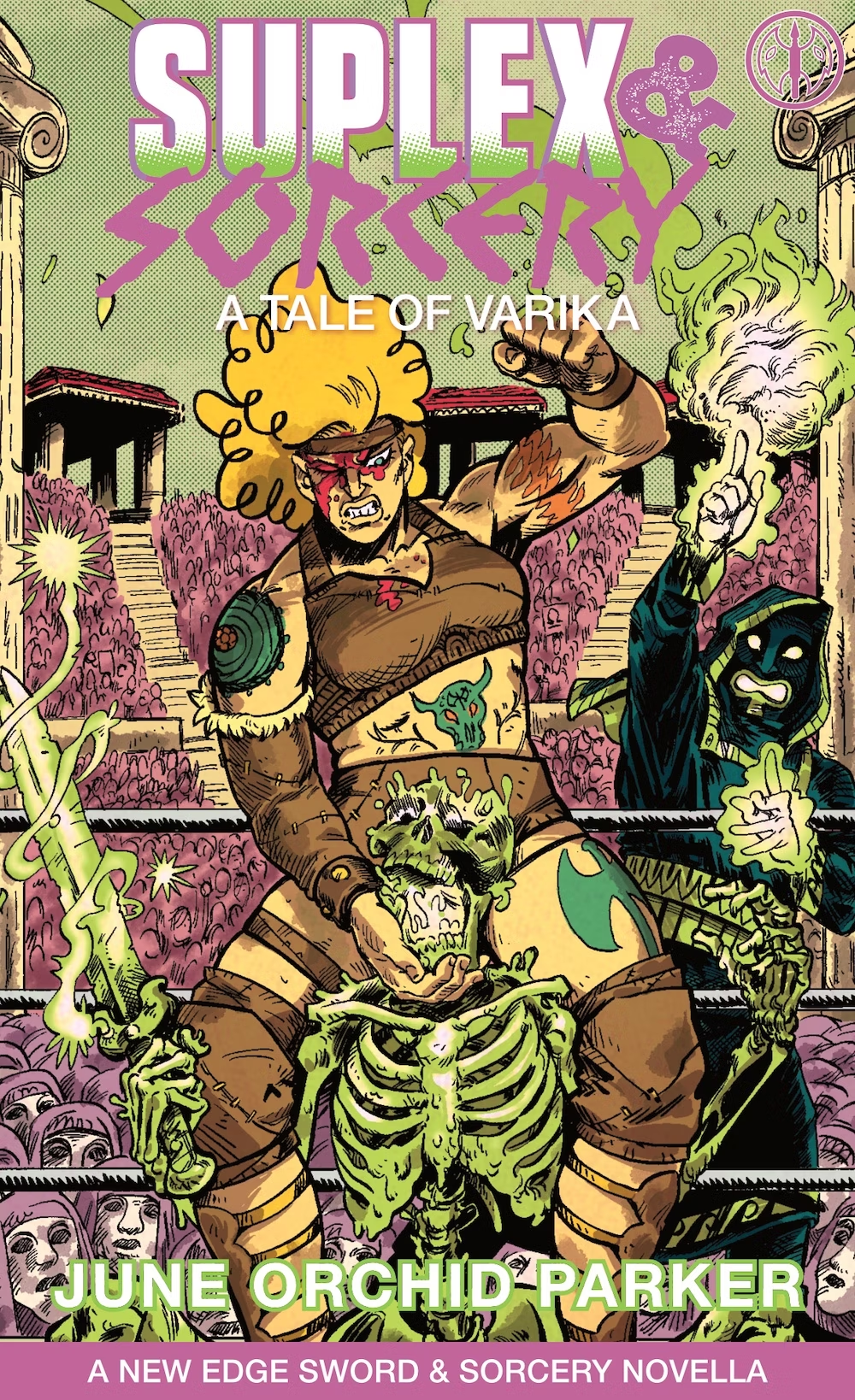
“…In other words, the story really is a love letter to professional wrestling, and it shows, in a lighthearted and fun way, how a wrestling league might form in a sword and sorcery city.”

I’ve been a fan of Jo Graham since her Black Ships (2008), a re-imagining of the Aeneid from the perspective of a priestess. Although she has written a good deal of science fiction (her Calpurnian Wars series and numerous Stargate tie-ins), much of her work has focused on historical fantasy, ranging from the ancient world (her Numinous World novels that started with Black Ships) through the Napoleonic era (The General’s Mistress, etc.) to The Order of the Air, the 1930s series co-written with Melissa Scott that I wrote about in 2018. When Graham’s fantastic Italian Renaissance series debuted in 2023 with A Blackened Mirror, I missed it, along with the 2024 sequel, The Borgia Dove. Now, just ahead of the release of The Blood of the Bull, I have finally caught up, and I’m so glad I did! The Memoirs of the Borgia Sibyl series focuses on Giulia Farnese, a real-life Italian noblewoman who became the lover of Cardinal Rodrigo Borgia. Having some knowledge of history, plus recently listening to Ada Palmer’s Inventing the Renaissance: The Myth of a Golden Age (2025), I was aware of the basic beats of Borgia’s career, although I knew nothing of Giulia. Graham has done a great deal of research and has quoted letters from Rodrigo and Giulia on her Patreon. All the books start with family trees, explanations of timekeeping in Renaissance Rome, and lists of important People, Places and Things, but I mostly skipped over those, trusting Graham to explain what I’d need to know as the story progressed. This was justified, but then, I’ve read a lot of historical novels; others may find these elements extremely helpful, especially since the cast of characters is large. What is not historically recorded is Graham’s version of Giulia being a seer with mystic powers. Early in the first book, she descends into some ancient tombs and begs Persephone to rescue her from her expected destiny of maiden aunthood. Her pleas are granted in very unexpected ways, and her connection with the numinous persists throughout the events of each book, including learning how to cast protective wards against evil, and more. Given that this is based on real history, I don’t think it’s much of a spoiler to say that by book 3, Rodrigo is now Pope Alexander VI. Giulia has assisted in his rise, participating in political intrigues and foiling assassination attempts by various means. The question is, having gained great power, can they keep it against old rivals and new threats? A shocking turn of events sends Giulia fleeing Rome, making herself vulnerable to both French invaders and the ascetic extremist Friar Savonarola. Will Giulia and Rodrigo be able to overcome their internal and external challenges, and save themselves, Rome, and the progressive faction of the Church? Or must the blood of Borgia, whose house emblem is the Bull, be shed and sacrificed to protect all that they cherish? I am really enjoying this series. Giulia is kind, clever, resourceful, and brave, an entirely engaging protagonist. Trapped in a bad marriage, used and endangered by her in-laws, and seeing many examples of rule-breaking in Roman society, it’s natural that she looks for love and protection elsewhere. And although modern eyes would see her relationship with Rodrigo as a May-December romance at best, starting with her being 15 and him 58, I love Graham’s depiction of their courtship and bond. Although he has great temporal and ecclesiastical power, she brings her own resources of perception, intuition, social networking, female-coded skills like the languages of clothes and jewelry, and mystic power into the balance. They are sweet, caring, and considerate of each other (except for rare quarrels), and their wordplay and games are often extremely amusing. And they are extremely sensual and sexual together! Graham excels at depicting intensely warm ongoing relationships that blend earthiness and spiritual aspects, and this comes very much to the forefront here. But it’s not just the Giulia and Rodrigo show. Giulia has brothers and a mother (and in-laws), Rodrigo has sons and daughters (despite his clerical station), and both of them have extensive networks of allies and clients. On the other side are Giulia’s in-laws and the leaders and agents of those who oppose Rodrigo for reasons of nationality (he’s a Spaniard, while most Cardinals are Italian), doctrine (he’s humanist, they’re reactionary), and pure power. Graham weaves the plethora of personal threads to create a rich and brilliant tapestry of life in the Italian Renaissance, highlighted by magical underpinnings and subtle sparks. I was planning to space out these books a bit more, but I was so engrossed by the first novel that I bumped the rest up in my reading schedule and gobbled down the next two in the space of two days. I highly recommend these novels for fans of historical fantasy and romance. The Blood of the Bull will be published on July 7; you can preorder it here. The first two books are available at Candlemark & Gleam. At least one more book, A Golden Branch, is planned in the Memoirs of the Borgia Sibyl series. Content warnings (series): Disease, killings, riots, violence; religious and ethnic persecution; religious patronage and corruption; sexual discrimination and coercion; sex scenes, infidelity, and illegitimacy; curses and black magic. Comps: The Emperor’s Agent, by Jo Graham. Disclosures: As mentioned, I’m a longtime fan of Jo Graham; I used to talk with her on LiveJournal, and I support her on Patreon. I received free eARCs of all three books in the series (so far) from the publisher for review.

Those who haven’t yet read the 2023 World Fantasy Award winning novel Saint Death’s Daughter by C.S.E. Cooney should correct their omission as soon as feasible. It’s a story that took me by surprise, equally startling and delightful. The novel starts out with all the hallmarks of a coming-of-age dark fantasy with a complex, gothic world-building that invokes vibes of Tamsyn Muir’s Locked Tombs series. Its plot and its young protagonist Miscellaneous (Lanie) Stones could suggest a YA novel emphasis and expectations, but the writing proceeds to reveal an intermingling of classification and styles to create a voice that is just captivating. There are serious moments of violence and raw emotion alongside lighter moments of playful wit alongside academic footnote asides. The trajectory of the novel also shifts multiple times, in multiple ways expertly guiding readers from expectations and transcending Saint Death’s Daughter beyond a typical coming-of-age fantasy. Cooney accomplishes this so well through both the rich world-building and characterization. It’s therefore an understatement to say that the novel’s sequel was highly anticipated by fans, including myself. Out now, Saint Death’s Herald may not surprise or pull readers through turns like the first novel did, but it should still delight readers as a compelling continuation of Lanie’s story that expands the folkloric elements of this universe and widens readers’ insight into characters. Saint Death’s Herald begins just following the conclusion of the first novel, with Lanie in pursuit of Irradiant Stones (Grandpa Rad), whose ghost has taken over the body of Cracchen Skrathmandan and is headed toward the icy realm of Skakhmat to continue his search for power that led to his death there ages ago. Along with her St. Death-blessed magic, Lanie has the loyal were-falcon Duantri (as well as Stripes the reanimated tiger-rug) at her side to stop Grandpa Rad from enacting the further genocide necessary to achieve his goals. From page one Cooney sets up Saint Death’s Herald as similar, but quite distinct from the first novel. The compelling voice mixing light- and heavy-hearted moments remains, but Cooney replaces the slowly building coming-of-age framework with a quick-moving Hero’s Quest structure that doesn’t let up until a brief mid-way point of more relaxed planning that then directly leads to the novel’s denouement and climax. This second novel thus follows a far more linear and expected path than its predecessor, removing a lot of thrill that could come from unpredictability. That isn’t to say that this linear journey isn’t also delightful and fulfilling. First off (or last off, depending on the reference point here), Cooney nails the novel’s ending with positive affirmations of the series’ themes of love, kith, and kin. Secondly, she features a fascinating shape shifter culture at the core of the journey to really enhance the world building of this series beyond merely rehashing the cultures she already delved into in book one. Thirdly, Cooney switches things up from Saint Death’s Daughter by focusing on other characters in Saint Death’s Herald. After becoming enraptured with Mak and Datu in the first book, some readers may be disappointed to find them in the background here. At first, that included this reader, but I slowly began to appreciate what Cooney was doing with this novel and began to enjoy and appreciate the new perspectives and character focus. Lanie remains at the heart of things, but getting other points of view does make the novel and world feel grander. I personally don’t care for Duantri (she seems to lack emotional and moral complexity that others may have so far) , so sections through her eyes were least enjoyed. However, I found Cracchen fantastic. After the ghost of Grandpa Rad vacates his body and some Sky Wizards collectively take his place, Cracchen becomes a fascinating character that opens the novel up to explore its key themes. I assume there will be a third book to this series, if not more novels. Saint Death’s Herald reads like a middle novel, starting fully engaged without any recap or introduction to get settled. (I had to reread my and other reviews of the first book after starting this because I had forgotten so many details and secondary characters.) Though great, it does lack a certain magic of discovery and surprise that makes it feel a little less than the original. It switches things up to keep fresh while retaining the core elements that positively define the series. Yet, unlike other ‘middle episodes’ it ends resolutely without relying on a cliff-hanger while still promising more revelations of Lanie Stone’s journey alongside Death in this vivid universe where even darkness is colorful and radiant.

The synopsis for Sarah Maria Griffin’s Eat the Ones You Love would understandably invoke thoughts of Little Shop of Horrors for most people. I also kept thinking about Sue Burke’s Semiosis trilogy, not in terms of the plot, but in the sentient plant character and point-of-view perspective.

Mary and the other viewpoint characters are a lot of fun to follow through their adventures and evolutions, and Murphy’s insights into storytelling and explorations of the Victorian/Edwardian period are as entertaining as they are enlightening — Murphy examines historical horrors rather than glossing over them, but her characters overcome these challenges with verve.

This is a book not quite about the power of books and doors and going places by opening one, but instead, it is a twisting and intricately devised narrative of stable time travel loops. Brown has a lot of fun in the novel…