
Varika is far from home, in the city of Metroniam. A Nemavian fighter like Varika in the big city needs to earn a living just like anyone else. While she is a ferocious barbarian, she’s not all that good with weapons; instead she’s very good at fighting with her bare hands. Enter the A.W.L., the Apheneian Wrestling League. A chance for fame and fortune for a barbarian better with her hands than with a sword. And so a wrestling storyline is born as Varika finds that the stories inside and outside of a ring can become painfully and truly real and start to blur together. Especially when there is a sorcerer involved.
This is the setup for June Orchid Parker’s Suplex & Sorcery, one of four New Edge Sword & Sorcery Novellas being fundraised together by Brackenbury Books. [https://www.backerkit.com/c/projects/brackenbooks/new-edge-sword-sorcery-novellas-2025]
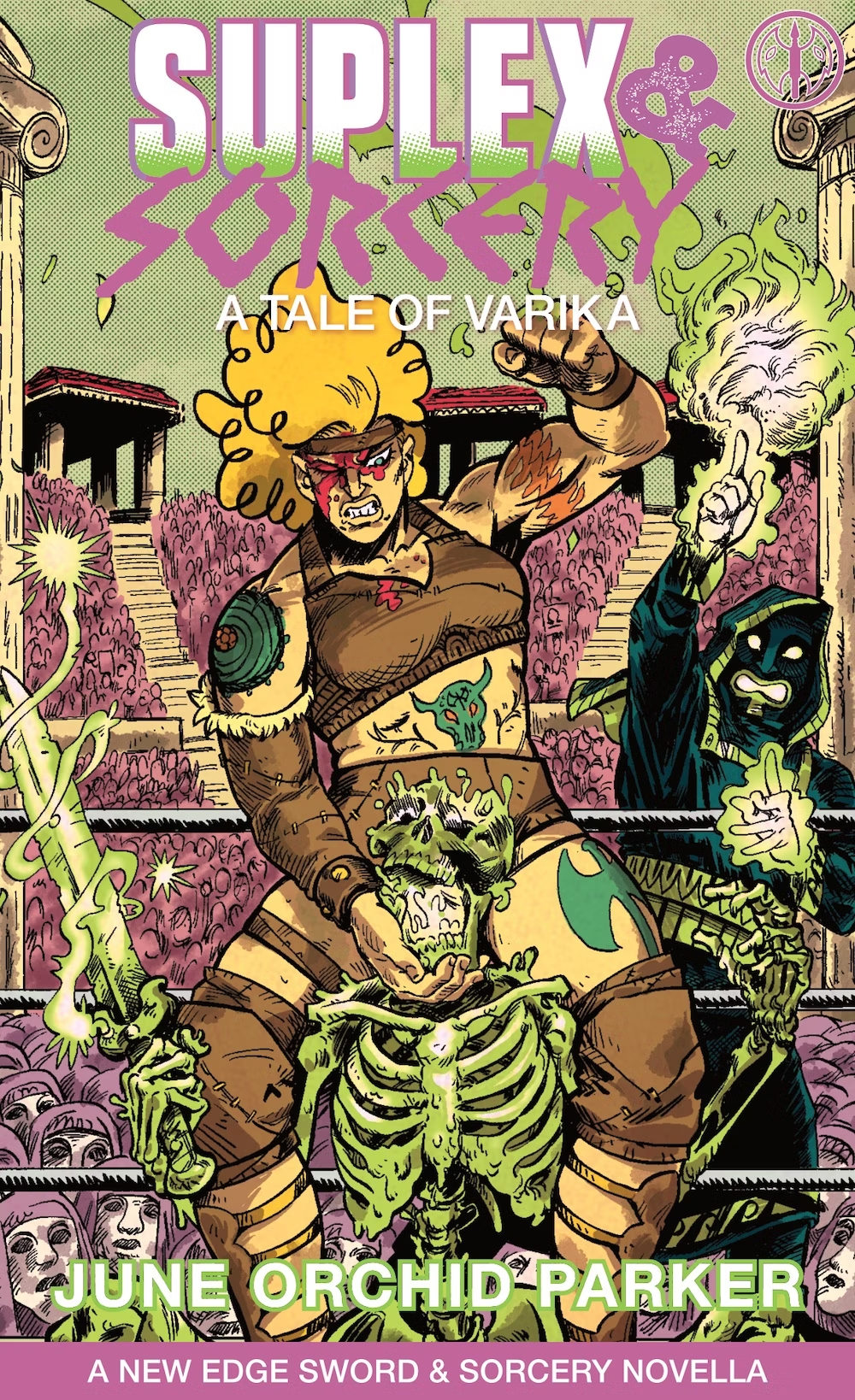
The idea of wrestling as being a thing in sword and sorcery is not precisely new, although this is the first time I’ve seen it directly done by a protagonist and seen an actual wrestling league or matches within a sword and sorcery story. Think back to the 1980s movie Highlander, which is sword and sorcery and urban fantasy and is a movie without any sequels whatsoever. That movie begins in the present day with Duncan MacLeod going to a wrestling match at Madison Square Garden, and then getting into a sword fight in the parking garage after the match. So the connection between staged violence with a story and a plot and actual violence in a more traditional sword and sorcery narrative is not unknown.
In Suplex & Sorcery, we follow Varika as she becomes a fan favorite babyface, and gets wrapped up in a plotline devised by the manager of the A.W.L, Kleon. Varika has been a wrestler in the A.W.L for some time now, and clearly Kleon has decided Varika should have a push, with unexpected consequences. The story of the novella is told as a dictation from Varika to a scribe and friend, Tythes, for a letter to be sent home. This sort of framing device allows Varika to explain in detail just how this world of wrestling works, since her rural family and friends have no conception of the big city, or wrestling matches within it.
And so in this novella, we get a lot of loving detail on how a wrestling ring is constructed in a fantasy world, what it’s made of, and how matches really work. While the details of matches are less detailed for matches that Varika is not involved in, there is just enough detail to satisfy fans of the sports entertainment. The writing style is breezy and shows just enough to keep the story flowing when all we need to know between two secondary characters is who pinned whom.
We thus, in addition to Varika, get a variety of her fellow wrestlers as characters, and follow their matches and relationships, even if the main story focuses on Varika. The terminology used is a mixture of wrestling terms, and alternate terms and descriptions translated into a fantasy perspective. We get a variety of matches, too, including ones that allow for outside objects, tag-team matches, and even cage matches. The wrestling mythos and storylines as a concept enters as well. One of the characters “has to lose a lot to earn his dues”. He is clearly, in wrestling parlance, a jobber although the name is not used. There is concern at one point that a wrestling match has gone off-script and there is even a ring wreckage. There are even championship trophies (instead of belts) which are won or lost in a few matches.
In other words, the story really is a love letter to professional wrestling, and it shows, in a lighthearted and fun way, how a wrestling league might form in a sword and sorcery city. Of course, since this IS a sword and sorcery novella, there are both of those as well. Varika, in the course of her “storyline”, runs afoul of a sorcerer (a clear Heel) with an agenda all their own. As Varika battles to win matches and face the sorcerer and their allies (including the skeleton that we see in the art for the story), we get a sword and sorcery tale, lighthearted, where all of the combats and confrontations are within or adjacent to the squared circle.
When Varika finally gets into a position to confront and challenge the sorcerer, it is not in their lair, or down a city street. No, it is in a series of wrestling matches. The “real” story of the sorcerer and their plans and plots intermix with the “wrestling storyline” that Varika has been inserted into, and the blurring of the lines between the two is delightful.
The writing of the story, using the epistolary format mentioned above, allows the author to have Varika reflective of what happens, set up foreshadowing of events, and provides room for the character’s voice to shine. The matches, especially, are entertaining to read. The writing style does not presuppose a need for knowledge of the ins and outs of wrestling (since Varika is explaining it all to her family in the letter) but having that knowledge does reveal that the author herself has a deep and abiding knowledge of it. Through the wrestling matches and beyond, we get a good sense of Varika as a character as a result. I was entertained throughout the course of the novella and it was a quick and easy read. It’s diverse, queer friendly, and fun. It’s perhaps the “lightest” sword and sorcery story I’ve ever read and an interesting example of what you can do with the form that hasn’t been done previously. If Sword and Sorcery can often shade into Grimdark fantasy, this novella is diametrically opposite that trend and tendency.
And yes, there is a suplex slam.
