 I’m done with TNT’s Falling Skies. This is the second science fiction TV show they’ve produced that I’ve given up on and I’m starting to see a trend. The first was The Walking Dead, which suffered from many of the same issues that make Falling Skies such a weak piece of science fiction. Namely, the moronic use of the generic/subgeneric conventions (for The Walking Dead, post-apocalyptic zombie survival; for Falling Skies, post-alien-invasion post-apocalypse survival). But if failing to use the clichés of the genre effectively weren’t bad enough, perhaps the series’ blatant political agenda and its wishy washy handling of normally interesting and relevant subjects (to Americans) kills the show for good.
Falling Skies, essentially, is about how conservative America—in the current conception of that ideal—can save mankindfrom the liberal assault on the religious binary of good and evil (i.e., inserting a little grayness into modern life). Never mind that it does so in a way which implicitly ignores the reality of its situation. The liberal ideology must be proven false, despite the implied binary relationship between mankind and their exterminators (i.e., the aliens) and the desperation of humanity’s bid for survival. This is made blatantly clear in at least two instances in the fourth episode.

The first occurs when the bleeding heart liberal medic suggests that trying to hurt the captured skitter (alien) is a bad idea, because it has feelings too (read civil rights and animal rights here); she’s told, of course, that her ideals are misguided, and by the end of the episode, the conservative “truth” is made real and the bleeding heart liberal is put in her place (gender is also important in this show, since it supports heteronormative patriarchy over anything else). The second is a direct rejection of the idea of prison reform, an inherently liberalist notion which suggests even today that not all criminals are unsalvageable and that many are the product of socio-economic factors. Over the last two episodes, the one prisoner in the group is gradually reintroduced into society, and then tears down the liberalist foundations by betraying the main characters while out on a mission, stealing a motorcycle, and fleeing (putting the scouting part in imaginary danger, since nothing terribly worrying occurs). It should be noted that neither of these are particularly subtle incidences.
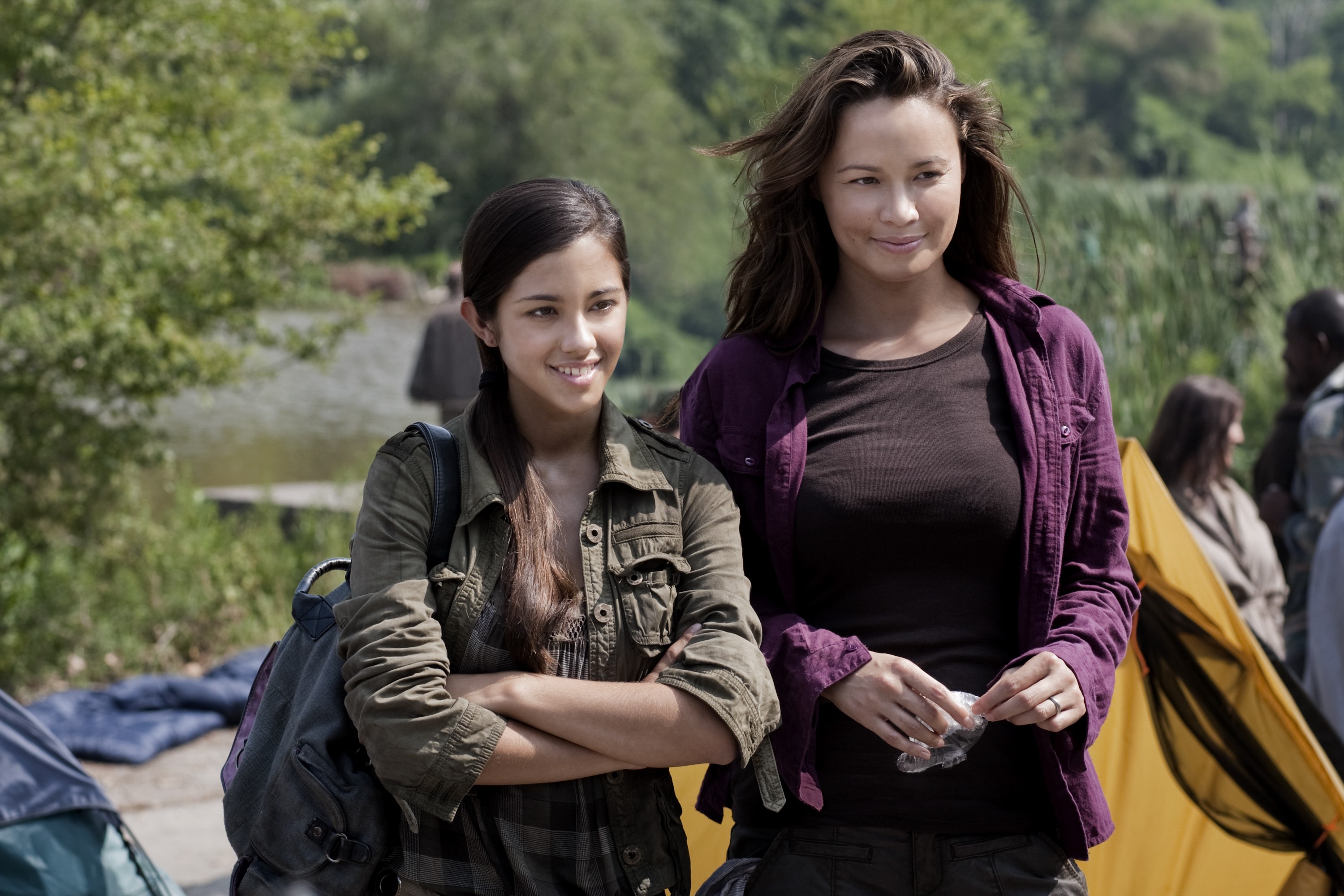
Where Battlestar Galactica addressed a myriad of very “present” political and social issues in complex ways (sometimes supporting the conservative position, where logical, and other times finding the liberalist notions more appropriate for the narrative), Falling Skies beats you over the head with them to remind you how important its internal and external ideals are. The previous examples make this obvious, but the show’s religious overtones perhaps do the most damage by making Falling Skies as crucial a genre product for conservative America as the Left Behind series (and its authors). One of the recurring characters is a teenage girl who interacts with the faithless survivors only in religious terms. She prays for people she doesn’t know at a board for lost children (about which she is questioned and has to explain her religious ideology), prays at meals, tells people about Jesus, and so on. She’s the evangelist of the group, but her constant push about faith and needing faith has as much relevance to the narrative as Americans seem to place on science in their day to day lives. It serves no clear function other than to peddle a particular political view onto viewers. Unlike BSG, which took its religious themes seriously, delving in the complexities of faith, Falling Skiesslaps us over the head with it, showing characters adopting (or re-adopting) religious faith without any clear reason to do so.

I don’t much care for this kind of ideological work in my science fiction. Touting a conservative slant on a common science fiction concept isn’t an inherently off-putting thing for someone of my political affiliations (crazy liberal). Rather, it’s the way the series hamfistedly inserts its anti-liberal ideology over a wall of illogical narratives, poorly-crafted characters, and poorly-adapted clichés, which makes the project beneath it so obvious as to feel like I’m watching Pat Robertson “news” program filtered through science fiction. Never mind that the aliens are almost as inept as humanity, begging the question: how did they defeat humanity in the first place? Never mind the predictability of the characters and the family drama and the lack of character death. The pathetic use of politics is what kills this show.
That’s what made me stop watching, and what will prevent me from coming back ever again.
(After four episodes, the following is how I would score the show:
Directing: 1/5
Cast: 2/5
Writing: 0.5/5
Visuals: 4/5
Adaptation: N/A
Overall: 1.875/5)
