Book Review: Suplex & Sorcery, by June Orchid Parker
“…In other words, the story really is a love letter to professional wrestling, and it shows, in a lighthearted and fun way, how a wrestling league might form in a sword and sorcery city.”

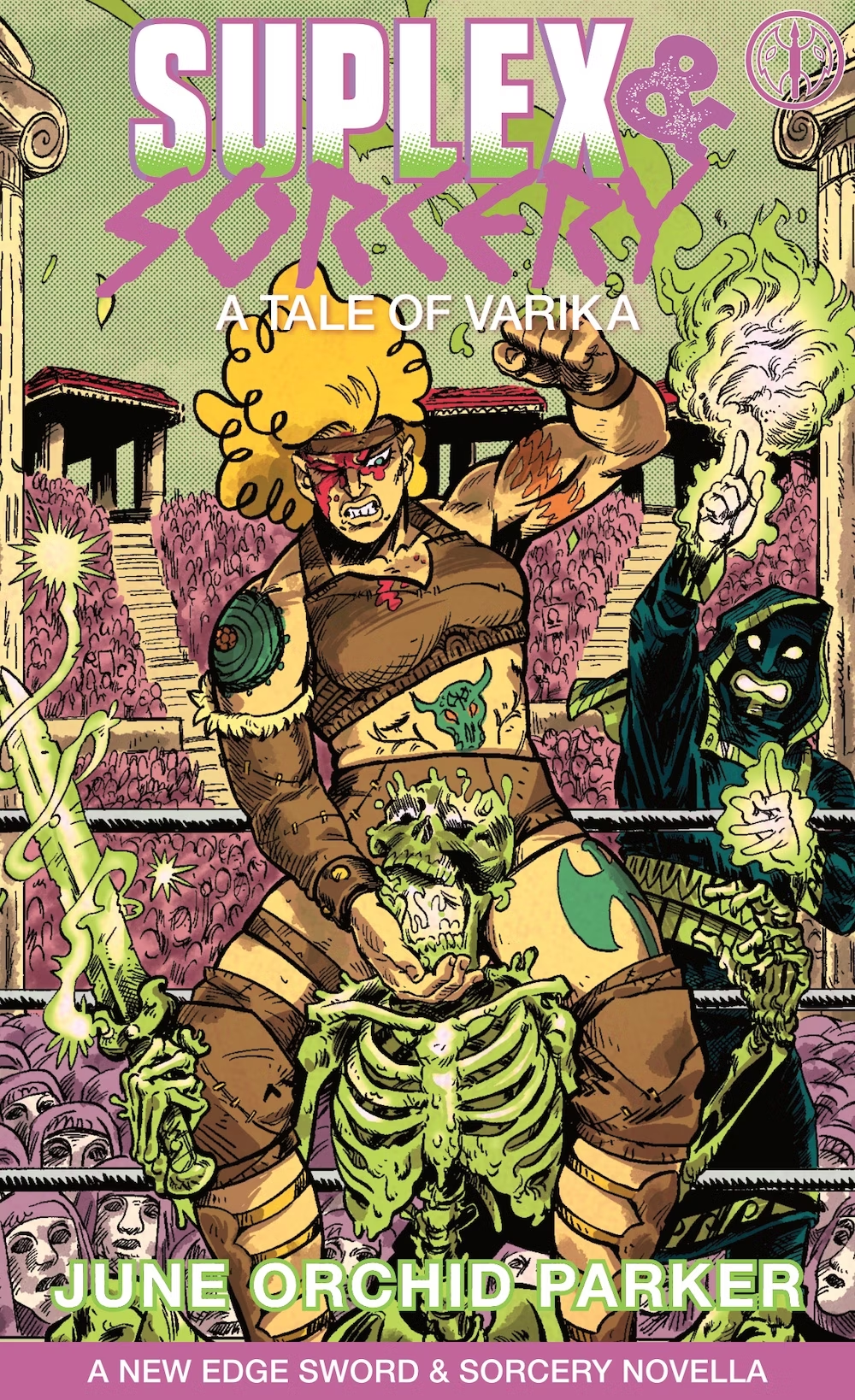
“…In other words, the story really is a love letter to professional wrestling, and it shows, in a lighthearted and fun way, how a wrestling league might form in a sword and sorcery city.”

Readers who are at all interested in how and why Rome has been an influence on cultures for 2,000 years will enjoy this well written, informative and engaging book.

In any event, if you are hoping for futuristic Romans in Space where the Empire never fell, you are getting none of that here.

I thought the series was done, but over a decade and a half later, a third novel in the series, aptly called The Lords of Creation, has been published, and here we are.

I certainly didn’t mean to, not consciously. “Cozy fantasy” wasn’t a thing when I set out to write A Turn of Light, my first fantasy novel, but as the term’s used today? In hindsight, what a perfect fit! A bit of backstory, if I may. I kept my intention to write fantasy secret for decades. For a couple of reasons. Most importantly, I was already, and happily, writing science fiction for Sheila E. Gilbert at DAW Books, with several novels under contract, as well as editing my own anthologies. Not the best time to put forth such a, well, off-track notion. And, I confess, I was hesitant. Could I write the type of fantasy I wanted? Lyrical, filled with wonder, immersive—to write it, to do it justice, I’d have to find my fantasy voice, distinct from my science fiction one. To develop a living landscape in terms that wouldn’t feel like my customary science-based planet-building, even to me. I like challenges but those seemed daunting. (Note to amuse you later: I was also firmly convinced I could and must do all that in under 90K.) The easy part was knowing what kind of fantasy I’d write if I had the chance. It had to be joyous. No victims. No violence. No wars. I craved wonder and wild magic. More than that, I wanted a story with community. People who were kind to one another, coming together as needed to work to a common goal. You know, ordinary folks living ordinary lives, just surrounded by wild—as in natural—unpredictable magic, under no one’s control. Lacking the term “cozy,” I thought of it back then as my “cup of cocoa and a blanket on a chilly damp afternoon” story. To write, one day.

Creativity’s an interesting beast. It’s as diverse as people can be, don’t get me wrong, but when talking about it in general, I’m reminded of water, flowing along as water does. How some flows keep within defined channels, while others seep or surge, carving new paths as they go—with the occasional burst of overabundance to mess with both systems—but, in the end, water continues on wherever it was, on its way to wherever it will. If we think of a particular genre as a channel for creativity, it’s easy to imagine science fiction burbling down that one, fantasy tumbling through over there, (horror rumbling to itself in some underground cave system because it’s scary), with any/all free to mingle or separate again or even (gasp) evaporate. Writers may let a story evolve its own channel or pick a trusted one to flow along. The choice is theirs. It isn’t always the same. Bringing me to authors who change channels to write in multiple genres, such as writing science fiction, change their creative flow to fantasy for a book or two, then back again. It’s no simple process, hauling your creativity from an established, dare I say comfy, channel to let it go traipsing wildly down another, especially if it’s completely new to you. You see the channel, but what about the rate of flow? Are there rapids to relish or a waterfall of doom-like proportions? Do you have to worry about dams? Fish? I’ll stop now. Clearly many authors change channels to great creative results. Many of my favourite authors write both science fiction and fantasy, though the first time Reader-me encountered this tendency, I confess to consternation. Would I still love their storytelling there as much as here? Would they ever go back to what’d I’d loved first? (It’s all about Reader-me, you realize.) Would I drown in despair? Of course not. My authors, as I think of them, (Reader-me), capture my imagination and heart with whatever they write. [LIST BEGINS] C.J. Cherryh. I discovered CJ through her science fiction, falling in love with Pride of Chanur. By the time I found her fantasy, I’d have read her shopping list without hesitation. I remember hearing CJ say, on a panel, that switching genres refreshed her brain. Loved that idea, too. Oh, and Fortress in the Eye of Time is one of my top fantasy reads ever. Tanya Huff. Tanya is the first author I met in person, having bought her book from her when she was behind the Bakka table at a con. That was Blood Ties, what I suppose you’d call paranormal mystery crime thriller vampire yummy (Reader-me doesn’t do categories well). It was fresh and new to me and I loved her writing, since reading it all. I don’t love military SF—but when Tanya wrote An Ancient Peace, I trusted her. Yes, her science fiction, that book and the rest, sparkles with the character and humanity and all that I love in her fantasy. Martha Wells. Like millions of Reader-mes, somehow I didn’t find Martha’s work until Murderbot marched in to save me from the Pandemic, but once I did, I was smitten. When I found her fantasy, I didn’t hesitate. I started with Witch King, really enjoyed what I read and have been gobbling them since. (Though, like those millions of Reader-mes, I’ve saved shelf space for more SecUnit. Because.) Ursula K. Le Guin. Ursula’s The Left Hand of Darkness blew away my assumptions of what science fiction stories could say and I’m forever grateful. Then she did it again for fantasy with A Wizard of Earthsea. Very different genres, each rich and meaningful with power all their own. Sir Terry Pratchett. I read Terry’s Only You Can Save Mankind science fiction story about a boy who finds out his video game is a bit too real before I’d even seen such a game, which might explain why I’ve such fond memories of it. I’m also a huge fan of his incredible Discworld fantasy series. Lois McMaster Bujold. You’ll know her for her Vorkosigan series which, like Tanya’s, is the kind of thoughtful “military” SF Reader-me does enjoy. but when I do workshops on the power of science fiction, I use Lois’ classic Falling Free. She’s written a number of terrific fantasy novels as well, including The Sharing Knife fantasy trilogy. So many more! I’ve realized there are few among my favourites whose creativity doesn’t flow wonderfully hither or yon, science fiction or fantasy or other. But there’s one more I must mention. Andre Norton. I discovered science fiction when, on impulse, I pulled Andre’s The Star Rangers (later retitled The Last Planet) from my school library’s shelf and knew I’d found the type of story meant for Reader-me in every way. Filled with wonder, with big new ideas, with characters I cared deeply about—I’ve read everything of hers I could find. And while I stayed primarily a science fiction reader, devouring everything science fiction Reader-me could get my hands on, Andre Norton’s fantasy struck a deep chord with me and still does. I’m rereading her fabulous Witch World series now, inspired as always by how her characters do their best and refuse to give up. [LIST ENDS] Refreshing your brain. Doing your best while amazing readers. Changing channels. Sounds pretty good, doesn’t it? My sincere thanks to my authors and all those who let their creativity flow. Award-winning author and editor Julie E. Czerneda is a member of the Canadian Science Fiction and Fantasy Hall of Fame. She has twenty-five science fiction and fantasy novels published by DAW Books, as well as numerous short stories and anthologies. Julie’s works combine her training and love of biology with a boundless curiosity and optimism. Out now: Imaginings, Julie’s first short story collection, and standalone science fiction novel To Each This World, as well as the fourth installment in her beloved Night’s Edge fantasy series, A Shift of Time, coming July 22. Julie is represented by Sara